
 CONSTRUCTCHECK
Social Housing Guide
Awaab’s Law: what social landlords must do, and when
Plain-English deadlines for councils and housing associations
Awaab’s Law came into force for social housing in England on 27 October 2025. It sets legal deadlines for investigating and fixing damp and mould, and from 30 November 2026 it extends to more hazards. Here’s what it means in practice, and how to meet the deadlines without wasting repair budget.
What is Awaab’s Law?
Awaab’s Law is named after Awaab Ishak, a two-year-old who died in 2020 from a respiratory condition caused by prolonged exposure to mould in his family’s social rented home in Rochdale. The law puts fixed timescales on how quickly social landlords must respond to hazards that put tenants’ health at risk.
Awaab’s Law timescales at a glance
| Situation | Deadline |
|---|---|
| Emergency hazard | Investigate and make safe within 24 hours |
| Significant damp and mould hazard | Investigate within 10 working days of becoming aware |
| Written summary to the tenant | Within 3 working days of the investigation ending |
| Make the home safe | Within 5 working days of the investigation |
| Can’t make it safe in time | Offer suitable alternative accommodation at the landlord’s cost |
Phase 2, from 30 November 2026, adds further hazards such as excess cold, electrical hazards and fire. Phase 3, planned for 2027, covers most of the remaining Housing Health and Safety Rating System (HHSRS) hazards.
What counts as a proper investigation?
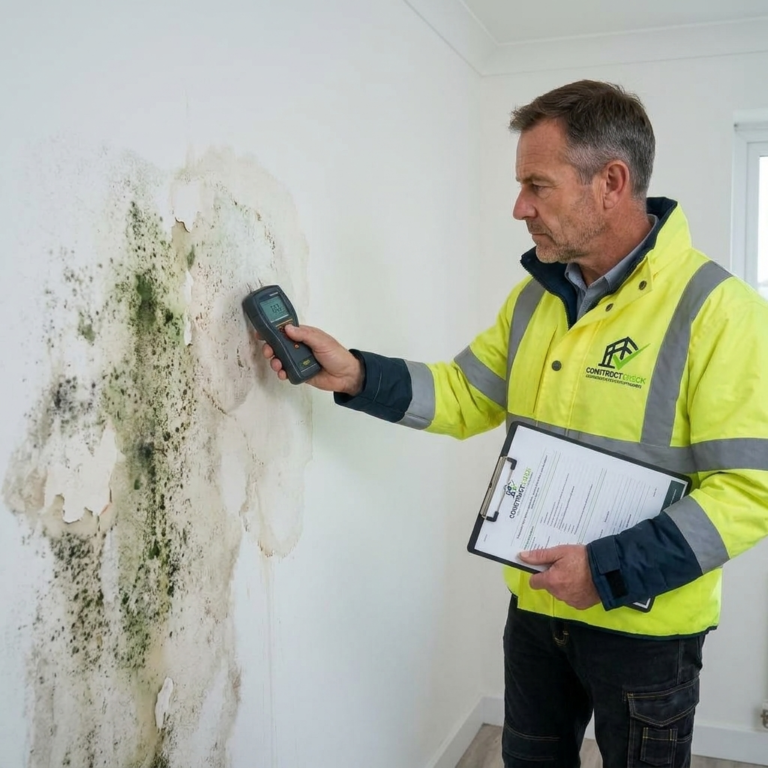
The deadlines only help if the investigation is good. A wipe-down and a look isn’t enough. A thorough damp and mould investigation should include:
- Moisture readings at different heights to tell condensation, penetrating and rising damp apart
- Room temperature, relative humidity and dew point readings
- Thermal imaging to find cold spots, missing insulation and hidden leaks
- Checks on extraction, trickle vents, gutters, seals and plumbing
- A clear HHSRS hazard rating and a prioritised works schedule
- Photos of every finding, so the decision is evidenced
Read more in what a damp and mould investigation should include, or see our sample report.
How independent surveys help you meet Awaab’s Law
- Speed: fast, evidenced investigations that fit inside the 10-working-day window
- Right first time: the root cause is identified, so repairs aren’t repeated
- Evidence: photo-backed reports that document what was found and why
- No conflict of interest: we never carry out the works, so the recommendation is purely about the evidence
Does Awaab’s Law apply to private landlords?
Not yet. The government is consulting on extending it to the private rented sector until 18 December 2026, and 2027 is the earliest it could apply. Full details in does Awaab’s Law apply to private landlords?
Need investigations done fast and right?
Independent damp and mould surveys for social landlords. Fixed fees, photo-backed HHSRS reports, no VAT.
Social Housing Surveys →Discuss a Batch© 2026 ConstructCheck (constructcheck.com). Written by Sebastian C, Registered Building Inspector and Level 3 Fire Door Inspector. All rights reserved. This article and its images may not be copied or republished without written permission. Original source: constructcheck.com